Fear and greed: the half a ranking cannot see.
SageRanks answers one question well: what does this company look like next to its peers, measured the way a particular investor measured. It says almost nothing about what the market is feeling today. That is deliberate, and it is worth explaining what we leave out.
What this site actually measures
Every ranking here is built from ten numbers per company: price to book, PEG, P/E, return on equity, gross margin, revenue growth, beta, RSI, analyst upside and the spread of analyst ratings. Five investor lenses weight those ten differently, and the same company can be first under one lens and unremarkable under another.
Nine of those ten describe the business. Only one, RSI, describes the mood around it, and it carries the lightest weight on the site: ×1, in Fisher's lens alone. Four of the five lenses ignore sentiment entirely. That is not an oversight we plan to fix. Graham, Buffett, Lynch and Greenblatt all built their methods specifically to avoid being moved by what everyone else was feeling.
Graham already named the problem
The idea that the market has moods is not a modern invention, and it is not opposed to value investing. It is Graham's own. His Mr. Market is an imaginary business partner who turns up every day with a price, cheerful one morning and despairing the next, and whose only real use is that you may deal with him when his mood suits you and ignore him otherwise.
So the two halves were always meant to work together. The fundamentals tell you which businesses are worth owning. The mood tells you when the crowd is likely to hand one to you cheaply, or to pay you far too much for it. Mr. Market is in our glossary, and Graham's essay spends most of its length on exactly this discipline.
What a fear and greed index measures
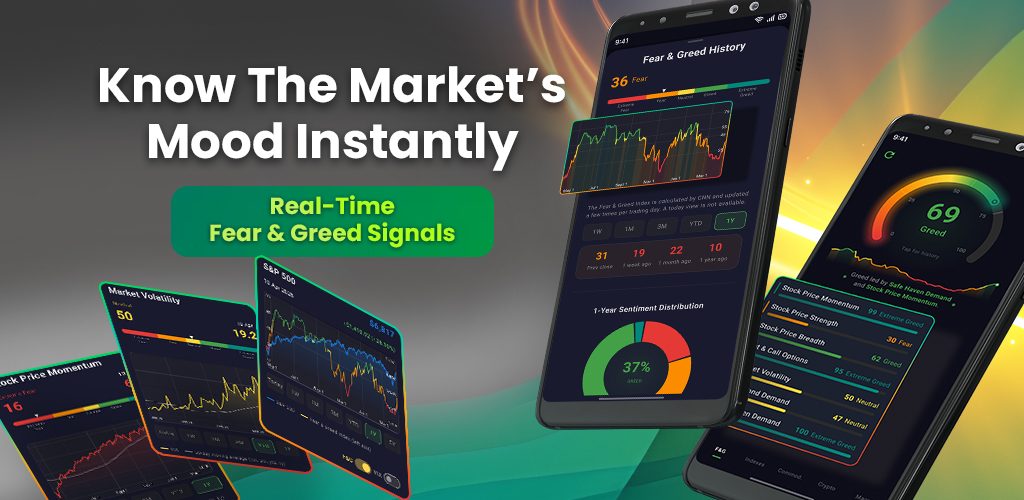
Where a ranking looks at companies, a sentiment index looks at the market as a whole, and it does it by watching how people behave rather than what they say. The best known version is published by CNN Business, and it is the one our app reads. It combines seven signals into a single number between 0 and 100, where low is fear and high is greed:
- Stock price momentum: how far the market sits above or below its recent average.
- Stock price strength: how many stocks are hitting new highs against new lows.
- Stock price breadth: whether volume is flowing into rising or falling shares.
- Put and call options: whether traders are paying up for protection or for upside.
- Market volatility: how much movement the market is pricing in.
- Safe haven demand: whether money is moving toward bonds or toward shares.
- Junk bond demand: what investors charge to lend to risky borrowers.
None of those seven is in our data, and none of them ever will be: they describe a market, not a company, and this site ranks companies within an index. That is the honest boundary of the tool.
The same markets, the other half
The overlap is not incidental. The app follows the live index for most of the markets ranked on this site — the FTSE 100, the DAX 40, the CAC 40, the OMXS30, Hang Seng, the Nikkei 225 and around thirty more — so a company you have just ranked here sits inside an index whose mood you can read there. Alongside those: commodities, the Fed funds rate, CPI, the yield curve and an economic calendar.
Two questions, two tools
That is why we built the second tool as a separate thing rather than bolting a mood gauge onto a ranking table. Fear & Greed reads the market; SageRanks reads the companies in it. Neither pretends to do the other one's job.
Used together the pair answers a question neither half can answer alone. SageRanks says this company screens well through Graham's rules right now. A sentiment reading says the market is fearful right now. Graham's whole argument is that the second is when the first is worth acting on. If you want the second half, the app is on Google Play, where it has passed five thousand downloads.